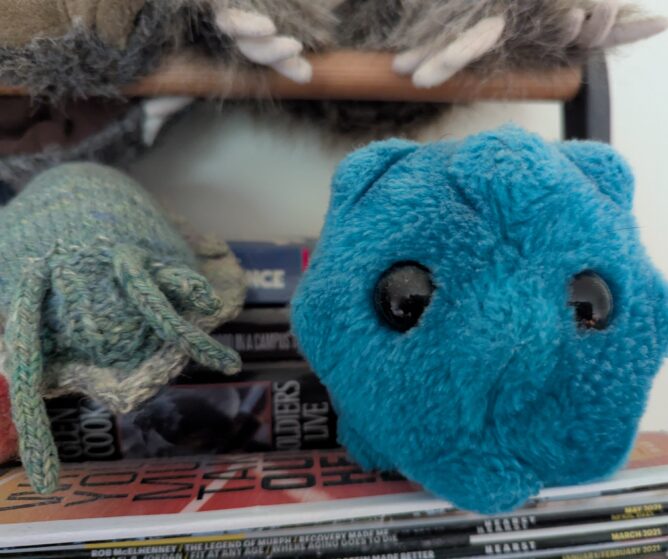
Most members of my HEMA club have painted their fencing masks in some way that’s meaningful to them.
I had long wanted to do so, but the thing I wanted to paint—the face of a sloth—was going to require at least three shades of brown, which I feared might be difficult to find. But when I finally went and looked on Amazon for acrylic paint markers, I found a set of acrylic markers in 12 different shades of brown!
I ordered them, they arrived yesterday, and I have painted my mask:
Recent news is that a contingent of ground forces have arrived in Iran. The markets still seem expect that Trump will chicken out (which seems likely) and that things will return to normal in the Gulf (which seems very, very unlikely).
My most hopeful guess at this point:
Trump chickens out, declares victory, says we have a deal with Iran, and pulls out.
Europe and Asia make a deal with Iran that conditionally opens the Strait, with Iran deciding who can transit, and collecting large tolls.
Europe and Asia start getting deliveries of oil and gas and fertilizer and helium. Because of the gap already embedded in deliveries, prices spike up in the meantime.
Because the U.S. is an oil and gas exporter, our prices spike up less (but still spike up, because there’s a global market), and reduced supply of fertilizer and other things from the Gulf means other prices spike up as well, producing an inflationary recession that rivals the worst of 2008 and 2020.
All my other guesses are similar, except that my scenario is preceded by a step 0 in which a bunch of U.S. soldiers and marines are killed while failing to reopen the Strait.
The U.S. has supposedly provided a “15-point plan” to Pakistan which has supposedly passed it on to Iran.
I have no idea what’s in that plan, nor what Iran’s reaction has been. But I do have some ideas about what would be a reasonable response by Iran. If I were in their shoes, this would be my starting point for negotiations:
We can resume enriching uranium, and start enriching it to levels that would allow us to build a nuclear weapon.
We can proceed to developing a nuclear weapon.
We can accelerate work on intermediate and long-range ballistic missiles.
We can continue to arm proxy organizations throughout the region.
The U.S. and Israel will pay us substantial reparations so we can rebuild destroyed facilities.
The U.S. and Israel will apologize for attacking us and killing our senior government officials.
Once these items have been agreed to, Israel and the U.S. will stop attacking Iran. Iran will stop attacking Israel, the U.S. and other Gulf states, except that we reserve the right to use military force in the Strait of Hormuz, and against other oil export facilities, such as those on the Red Sea.
As progress is made on these items, we will gradually reopen the Strait, under strict Iranian control, with the right to approve, inspect, and tax every cargo, in perpetuity.
[Updated at 16:56: I careless left off “End all sanctions” and “Return all frozen assets” from this list. Sorry!]
Now, I wouldn’t expect the U.S. or Israel to agree to all that, but it seems like a reasonable starting point for negotiations.
Trump is such a moron for having put us in such a situation. And he’s such a crappy negotiator, that I suspect we’ll end up with something very much like that before the war is over.
Oh, and I’m upgrading (downgrading?) my stagflation forecast to be more inflationary and more recessionary than I’d been assuming.
A pretty good run! 4.01 miles in 1h 5min 55s, for an average pace of 16:25 and an average HR of 140 bpm. I don’t auto-pause the run tracking, so if I’m running a 14-minute mile (still pretty slow) and stop for 2 minutes to take a selfie for the blog, that shows as a 16-minute mile.
I just heard a teaser for a story on how PDFs have become ubiquitous, with the supposed downside that AIs have a lot of trouble reading a PDF. The implication was that was bad, but I thought “Awesome! I’m going to have to switch to PDFs for more of my output! Oh, and I think I’ll start using TeX to produce more of that output!”
If you’ve ever read the contents of a PDF file produced by TeX you’ll understand.
Update: Turns out it was a story in the Economist. Here’s a gift link to the story (should get the first few people who click on it past the paywall):
The large language models underpinning generative AI are often bamboozled by PDFs, reading a page set in columns from left to right rather than top to bottom, say, or getting confused by headers and footers. Trouble parsing PDFs is one of the reasons AI chatbots occasionally “hallucinate”, generating nonsense.
I mean, for values of “money” that are totally confused about why LLMs hallucinate.
I’ve known since before the inauguration that the economy was facing stagflation. The tax cuts would boost the deficit, raising interest rates. The tariffs would boost prices, producing inflation. Both those things, plus forcing out immigrants, would tank the economy, producing stagnation (at best), yielding stagflation.
I wrote about this more than a year ago, in Our new upcoming stagflation. We are now seeing it, even before the war started.
I’m actually a little surprised we didn’t see it sooner. I credit the delay to a few things. First, Biden had left the economy in really good shape. It took a lot to tank it. Second, even though it seemed to us that Trump was “moving fast and braking things,” it’s just hard to move that fast on things like tax cuts, imposing tariffs, and deporting migrants—even if you’re willing to break laws to do it faster, these things take time. Third, Trump always chickens out, so we didn’t get the threatened tariffs on schedule; we got watered down tariffs after a delay.
However, the stagflation is here. Check out this graph of Real GDP. As you can see, in Q4 it had fallen almost to zero. The economy wasn’t shrinking, but it was stagnating.
At the same time, inflation had quit coming down. Here’s a graph of Core PCE, the Fed’s preferred inflation index. After getting down almost to 2% (the Fed’s target) about 8 months ago, it reversed course and has been bumping along close to 3% since then.
I think all of these things were about to get worse. Even with the Supreme Court’s ruling that a major part of Trump’s tariffs were illegal, there were plenty of others that aren’t going away. The tax cuts are still in place. Immigration has virtually come to a halt, many immigrants have been detained or deported, and any sensible foreigners with skills that they can apply elsewhere are fleeing the country.
So: Stagflation was already here. But things are about to get much, much worse, because now there’s a war on.
That has already spiked up oil prices. Those won’t feed immediately into Core PCE (which excludes food and energy prices), but will feed in over time, because higher energy prices make everything we produce more expensive. And, of course, wars are fantastically expensive, meaning that the deficit will blow out way worse than it was already going to, which will lead to higher interest rates (soon) and higher taxes (later).
Oh, and don’t expect AI to save us. If you listen to the business news, you know that the only reason the economy isn’t in much worse shape is that businesses have been paying huge amounts on AI infrastructure. As I wrote in my AI bubble post, I think a large fraction of the data centers and model training that that money got paid for will turn out to be worth much less than was paid for it.
So, where are we? Well, about where I thought we’d be, as far as the economy goes—in a modest stagflation that could be fixed pretty quickly, at the cost of a substantial recession, if the Fed had the guts for that. Except that now we’re in a war too.
I can tell you how to arrange your finances to survive a stagflationary period, but I can’t tell you have to survive a war. Wars are very bad, much worse than recessions.
If you know how to survive a war, let me know. If not, good luck.
When I was 2 years old, I was in the hospital twice with digestive issues, and came out with a diagnosis of celiac.
This was in the very early 1960s, when nobody knew diddly squat about celiac, and there were no gluten-free baked goods, and no indications on labels or menus that all kinds of ordinary things in restaurants and grocery stores had gluten in some form or another. My mom did the best she could to avoid giving me things with gluten in them, and taught me to explain to people who were trying to feed me that I couldn’t eat wheat, oats, rye, or barley.
I think nowadays people think that oats don’t have gluten, but we didn’t know that then, so we did our best to avoid all of them.
I ate this half-assed gluten-free diet until 1976, when went away for 6 weeks to a National Science Foundation summer program. I was living in a college dorm and eating in a college cafeteria, and found it too difficult to follow my diet. I found that my digestion was about the same as before, and just quit worrying about staying gluten-free. (Until I got married, and my wife thought that, if I had celiac, perhaps I should avoid gluten. And it was much easier in the 1990s to find gluten-free food.)
Fast-forward another decade or so. Blood tests for the antibodies to gluten became available. I got those tests done, and discovered that I’d never had celiac.
So, one thing I like to do these days is hark back to having to avoid “wheat, oats, rye, or barley,” and subvert it, by baking bread that contains wheat, oats, rye and barley.
In the years that I was particularly suffering from season depression in the winter months, I found various things that helped. (Click the SAD tag to see various posts on the topic.) One thing that was kind of in the middle in terms of both value and effort was taking myself on an Artist Date. (There’s an Artist Date tag as well.)
Lots of different things can quality as an Artist Date, of course, but I usually used the term to refer to going to someplace (anyplace) that I found inspired me. At the top of the list, because there’s already art, which helps me get into the right frame of mind, is to go to an art museum or an art gallery. But almost as high is going to a natural area, or some place like the Japanese Garden at Japan House.
I haven’t been particularly depressed this winter, but the Krannert Art Museum had an exhibit of textile art that Jackie wanted to see, so we decided to make an artist date of it. On a whim, we added the Conservatory, which has a greenhouse with a bunch of tropical flowers, and is always nice to visit in the winter, because it’s warm and sunny. (Sunniness, of course, depends on the sun being out.)
It’s hard to get a good picture of the art museum, except by just taking pictures of individual works of art, which I don’t like to do (out of courtesy and for copyright reasons), but I thought this one was valid:
There was a term (that I have already forgotten) for having numerous paintings covering the wall, rather than a spaced array of individual paintings.
And this one was produced as part of the WPA’s Federal Arts Project, by artists who were paid a modest wage to make art that belonged to the government (and all such work is copyright-free):
As I said, I wasn’t really depressed, so it didn’t so much matter that the Conservatory greenhouse gave us a clear view of the complete lack of sun: